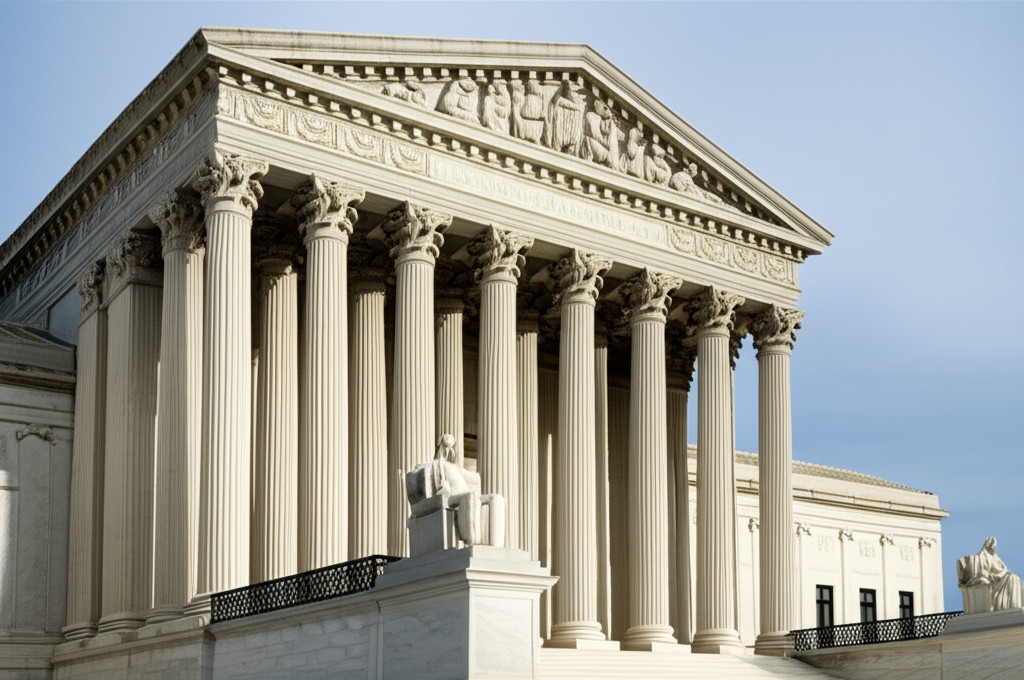
Supreme Court Rules Trump's IEEPA Tariffs Violated Federal Law in Landmark Constitutional Decision
In a landmark decision with far-reaching implications for executive power, the Supreme Court has ruled that former President Donald Trump's use of emergency economic powers to impose tariffs on Canada, Mexico, China, and a global 10% tariff contravened federal law. This ruling represents the most significant judicial check on presidential trade authority in decades, potentially reshaping the landscape of international economic policy and executive power in the United States.
Background on the Case
The case stemmed from the Trump administration's invocation of the International Emergency Economic Powers Act (IEEPA) to justify a series of tariffs aimed at addressing what it characterized as threats to national security. The tariffs, which affected key trading partners and caused diplomatic tensions, were challenged in the courts on the grounds that they exceeded the statutory authority granted by Congress.
The IEEPA, enacted in 1977, provides the President with certain powers to regulate commerce in response to unusual and extraordinary threats, but it requires a clear justification linked to national emergency. Critics argued that the administration stretched the definition of "national emergency" to an untenable extent, bypassing the legislative branch's authority over trade policy.
Constitutional Implications
The Supreme Court's ruling underscores the constitutional principle of separation of powers, reinforcing Congress's role in regulating commerce. By striking down the tariffs, the Court emphasized that the executive branch cannot unilaterally redefine statutory limits to expand its authority under the guise of emergency powers.
This decision serves as a crucial reaffirmation of checks and balances, signaling to future administrations that broad assertions of emergency power will face rigorous judicial scrutiny. The ruling may also prompt a reevaluation of other executive actions taken under emergency statutes, potentially recalibrating the scope of presidential authority across various policy areas.
Trump Administration's Response and New Legal Challenges
In response to the ruling, the Trump administration has pivoted to utilizing executive order authority to implement a new 15% tariff, raising questions about the legality and sustainability of this approach. Legal experts are divided on whether this maneuver will withstand judicial review, given the Court's explicit stance on the limits of executive economic powers.
Some analysts argue that reliance on executive orders to impose tariffs may encounter similar legal challenges, particularly if the orders lack clear statutory backing or if they are perceived as circumventing legislative intent. The new tariffs are likely to be scrutinized for their adherence to constitutional and statutory constraints.
Conclusion
The Supreme Court's decision marks a pivotal moment in the ongoing debate over the scope of presidential power, particularly in the realm of economic policy. As the Trump administration grapples with the ramifications of this ruling, it remains to be seen how future presidents will navigate the complex interplay of executive authority and congressional oversight in trade matters.
This case highlights the enduring importance of constitutional checks and balances, ensuring that no branch of government can unilaterally alter the economic landscape without appropriate legislative authorization. It is a clarion call for vigilance in preserving the delicate equilibrium of powers that underpins American democracy.
About the Author
Constitutional scholar and legal expert focused on originalist interpretations. "Adam Ivory examines how the U.S. Constitution should guide the regulation, deployment, and ethical use of artificial intelligence — without surrendering liberty to algorithms."